
Dutch environmental law and AI: a 60-second feasibility scan for real-estate developers
The Omgevingswet made Dutch zoning law more transparent, not simpler. Here is how BrickPilot combines public spatial plans with your project documents to deliver feasibility scans in minutes.
Contents
Why Dutch zoning law takes days, and why AI helps
Since 1 January 2024, the Omgevingswet has been the single regime governing spatial planning, environment, construction and water in the Netherlands. Twenty-six laws were folded into one stack, fronted by a single digital service (the Omgevingsloket). On paper: simpler. In practice: developers still need to determine, per site, which zoning plans apply, how transitional arrangements affect a parcel, and how local municipal rules interact with provincial and national law.
That work takes three to five working days before you know whether a plot is viable, days during which acquisitions stall and faster competitors move.
What BrickPilot does (and does not) do for you
BrickPilot is not a replacement for a lawyer or a planner. It is an AI co-pilot that takes over the first 80% of the exploratory work:
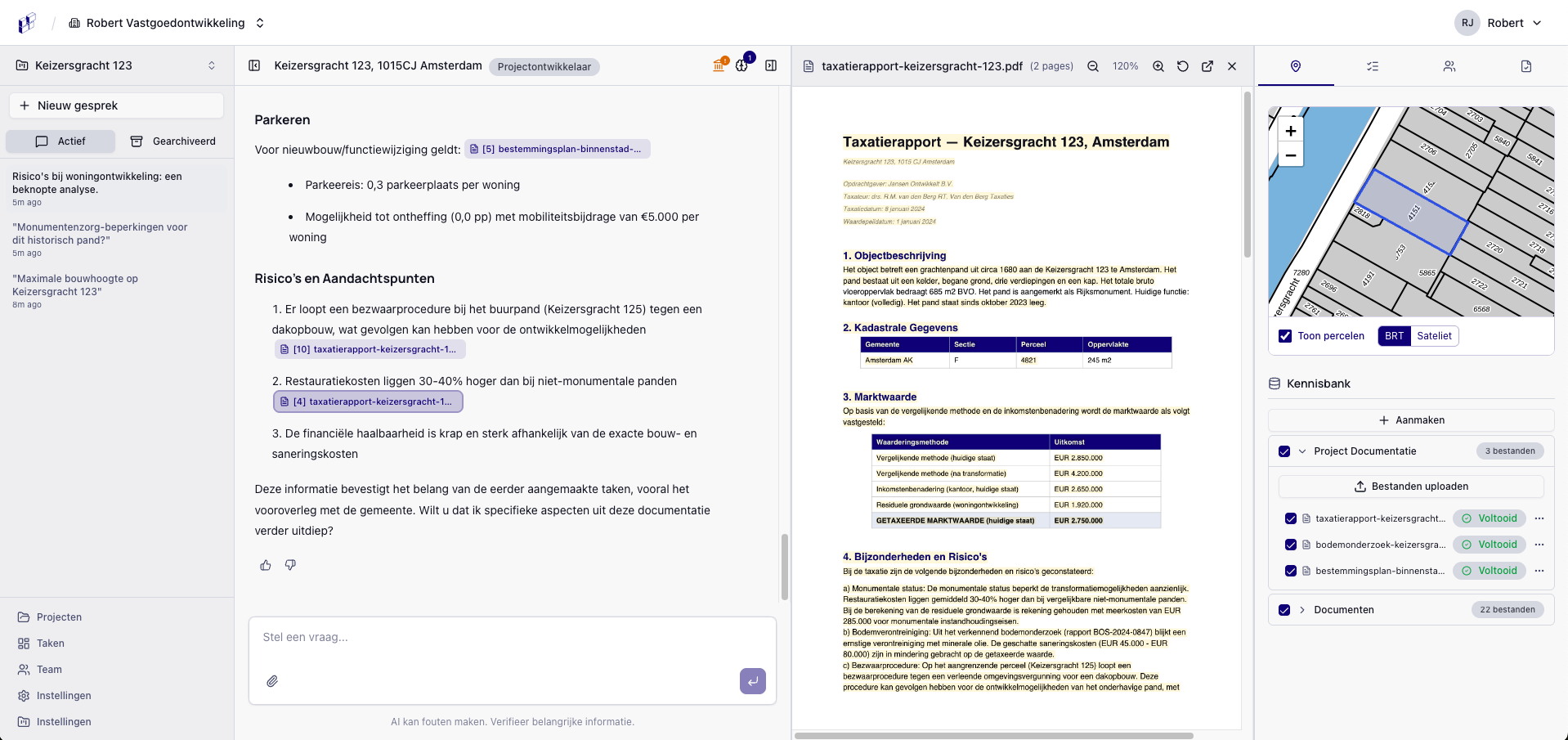
- Retrieve the zoning and rules: for every coordinate, BrickPilot pulls the binding zoning plans from the Omgevingsloket / DSO and Kadaster.
- Connect your project documents: soil report, appraisal, or draft design is indexed in a private per-project knowledge base.
- Answer questions with citations: every answer links back to the exact article of the regulation or the page of your document.
- Flag risks: protected cityscape, archaeological value, noise zones, nitrogen deposition are detected automatically.
What BrickPilot does not do: give you final legal advice, file a permit, or calculate full financial feasibility. That stays human work, but starting from a higher baseline.
A realistic workflow
Imagine a Friday-afternoon deal that needs an offer by Monday morning. Instead of burning a weekend:
- Friday 16:00: punch the address into BrickPilot; 60 seconds later you see zoning, maximum building height, plot coverage, parking rules, protected-status flags.
- Friday 17:00: upload the soil report into the project’s knowledge base, then ask the AI about contamination categories and remediation obligations.
- Monday 09:00: your team starts the real assessment: conversations with the municipality, financial modelling, legal review.
The savings are not in the first 60 seconds. They are in removing the first 80% of uncertainty before you bring in expensive specialists.
Why citations are non-negotiable
Real estate is a sector where one wrong answer can cost millions. General-purpose AI chatbots hallucinate. They invent article numbers that do not exist, or cite repealed provisions. BrickPilot cites every answer back to a source article in the Omgevingsloket / DSO or to the exact page of your own document. No citation, no answer.
This is what changes the liability picture: your team can verify each answer before it reaches a client or investment committee.
Further reading
The full Omgevingswet text: wetten.overheid.nl: Omgevingswet. Public spatial plans by address: Omgevingsloket: Regels op de kaart.
Want to see BrickPilot for your team? Start a free analysis or get in touch.
Frequently asked questions
What is the Omgevingswet in one sentence?
Since 1 January 2024, the Dutch Omgevingswet consolidates 26 older laws on spatial planning, environment, construction and water into a single regime with one digital front door (the Omgevingsloket).
Can AI replace a full feasibility study?
No. BrickPilot accelerates the first 80% of the discovery work (zoning checks, rule identification, risk flagging), freeing your team's time for the legal and financial depth that only humans should own.
How does BrickPilot know which rules apply to my project?
BrickPilot queries Kadaster and the Omgevingsloket / DSO for every coordinate to retrieve the binding zoning plans and rules. Those are combined with your own documents inside a private per-project knowledge base.
About the author
Manouk Termaaten
Founder & CEO, BrickPilot
Manouk founded BrickPilot to take feasibility research for developers from days to minutes, with AI that ties public regulations to project documents.
LinkedIn